Time History of Events and Macroscale Interactions during Substorms (THEMIS)
The routines in this module can be used to load data from the Time History of Events and Macroscale Interactions during Substorms (THEMIS) mission.
Fluxgate magnetometer (FGM)
- pyspedas.projects.themis.fgm(trange=['2007-03-23', '2007-03-24'], probe='c', level='l2', suffix='', get_support_data=False, varformat=None, coord=None, varnames=[], downloadonly=False, notplot=False, no_update=False, time_clip=False)[source]
This function loads Fluxgate magnetometer (FGM) data
- Parameters:
trange (
listofstr) – time range of interest [starttime, endtime] with the format ‘YYYY-MM-DD’,’YYYY-MM-DD’] or to specify more or less than a day [‘YYYY-MM-DD/hh:mm:ss’,’YYYY-MM-DD/hh:mm:ss’] Default: [‘2007-03-23’, ‘2007-03-24’]probe (
strorlistofstr) – Spacecraft probe letter(s) (‘a’, ‘b’, ‘c’, ‘d’ and/or ‘e’) Default: ‘c’level (
str) – Data level; Valid options: ‘l1’, ‘l2’ Default: ‘l2’suffix (
str) – The tplot variable names will be given this suffix. Default: no suffixget_support_data (
bool) – Data with an attribute “VAR_TYPE” with a value of “support_data” will be loaded into tplot. Default: False; only loads data with a “VAR_TYPE” attribute of “data”varformat (
str) – The file variable formats to load into tplot. Wildcard character “*” is accepted. Default: None; all variables are loadedvarnames (
listofstr) – List of variable names to load Default: Empty list, so all data variables are loadeddownloadonly (
bool) – Set this flag to download the CDF files, but not load them into tplot variables Default: Falsenotplot (
bool) – Return the data in hash tables instead of creating tplot variables Default: Falseno_update (
bool) – If set, only load data from your local cache Default: Falsetime_clip (
bool) – Time clip the variables to exactly the range specified in the trange keyword Default: False
- Returns:
List of tplot variables created Empty list if no data
- Return type:
Listofstr
Example
>>> import pyspedas
>>> from pyspedas import tplot
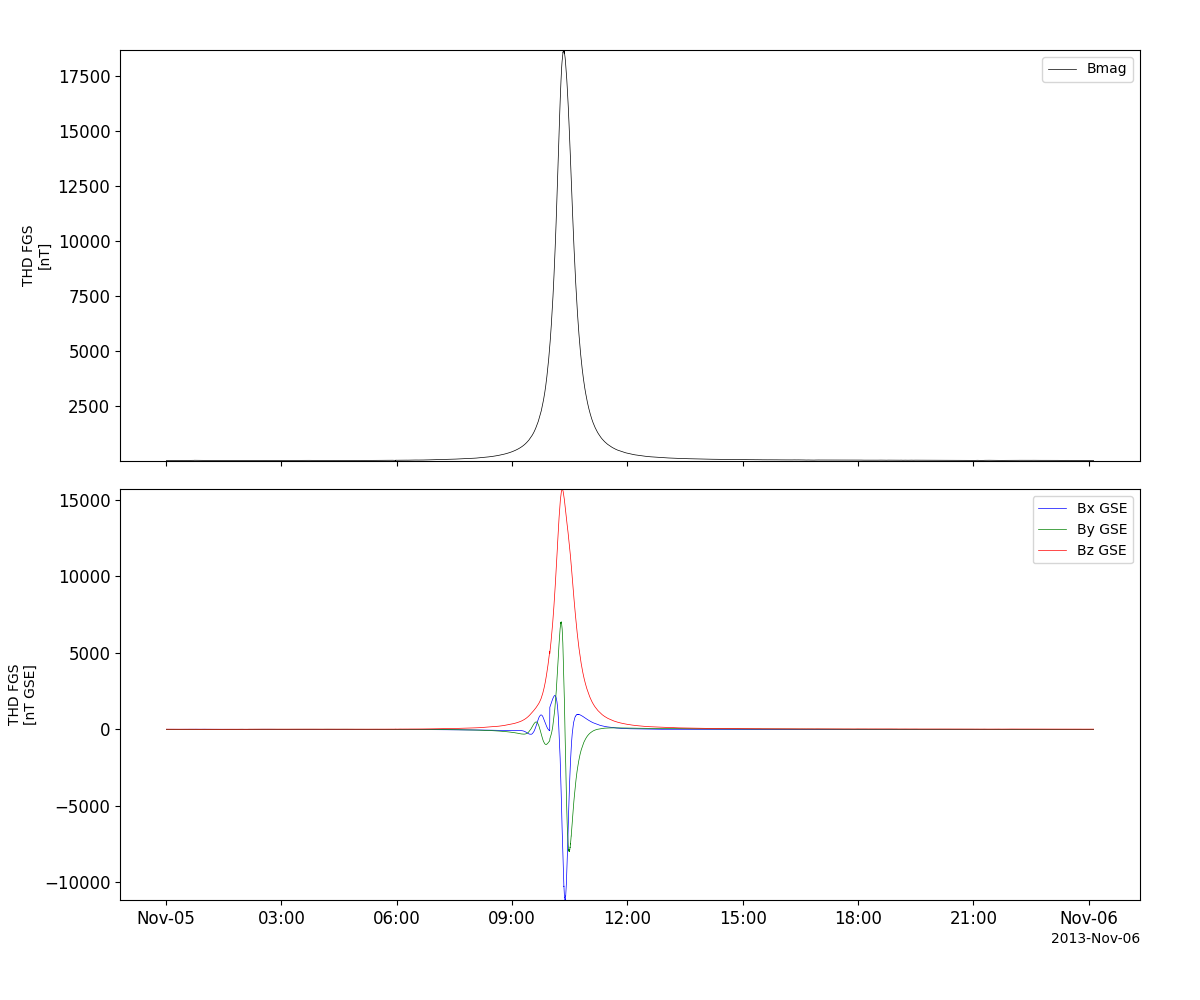
>>> fgm_vars = pyspedas.projects.themis.fgm(probe='d', trange=['2013-11-5', '2013-11-6'])
>>> tplot(['thd_fgs_btotal', 'thd_fgs_gse'])
Example
import pyspedas
from pyspedas import tplot
fgm_vars = pyspedas.projects.themis.fgm(probe='d', trange=['2013-11-5', '2013-11-6'])
tplot(['thd_fgs_btotal', 'thd_fgs_gse'])
Search-coil magnetometer (SCM)
- pyspedas.projects.themis.scm(trange=['2007-03-23', '2007-03-24'], probe='c', level='l2', suffix='', get_support_data=False, varformat=None, varnames=[], downloadonly=False, notplot=False, no_update=False, time_clip=False)[source]
This function loads Search-coil magnetometer (SCM) data
- Parameters:
trange (
listofstr) – time range of interest [starttime, endtime] with the format ‘YYYY-MM-DD’,’YYYY-MM-DD’] or to specify more or less than a day [‘YYYY-MM-DD/hh:mm:ss’,’YYYY-MM-DD/hh:mm:ss’] Default: [‘2007-03-23’, ‘2007-03-24’]probe (
strorlistofstr) – Spacecraft probe letter(s) (‘a’, ‘b’, ‘c’, ‘d’ and/or ‘e’) Default: ‘c’level (
str) – Data level; Valid options: ‘l1’, ‘l2’ Default: ‘l2’suffix (
str) – The tplot variable names will be given this suffix. Default: no suffixget_support_data (
bool) – Data with an attribute “VAR_TYPE” with a value of “support_data” will be loaded into tplot. Default: False; only loads data with a “VAR_TYPE” attribute of “data”varformat (
str) – The file variable formats to load into tplot. Wildcard character “*” is accepted. Default: None; all variables are loadedvarnames (
listofstr) – List of variable names to load Default: Empty list, so all data variables are loadeddownloadonly (
bool) – Set this flag to download the CDF files, but not load them into tplot variables Default: Falsenotplot (
bool) – Return the data in hash tables instead of creating tplot variables Default: Falseno_update (
bool) – If set, only load data from your local cache Default: Falsetime_clip (
bool) – Time clip the variables to exactly the range specified in the trange keyword Default: False
- Returns:
List of tplot variables created Empty list if no data
- Return type:
Listofstr
Example
>>> import pyspedas
>>> from pyspedas import tplot
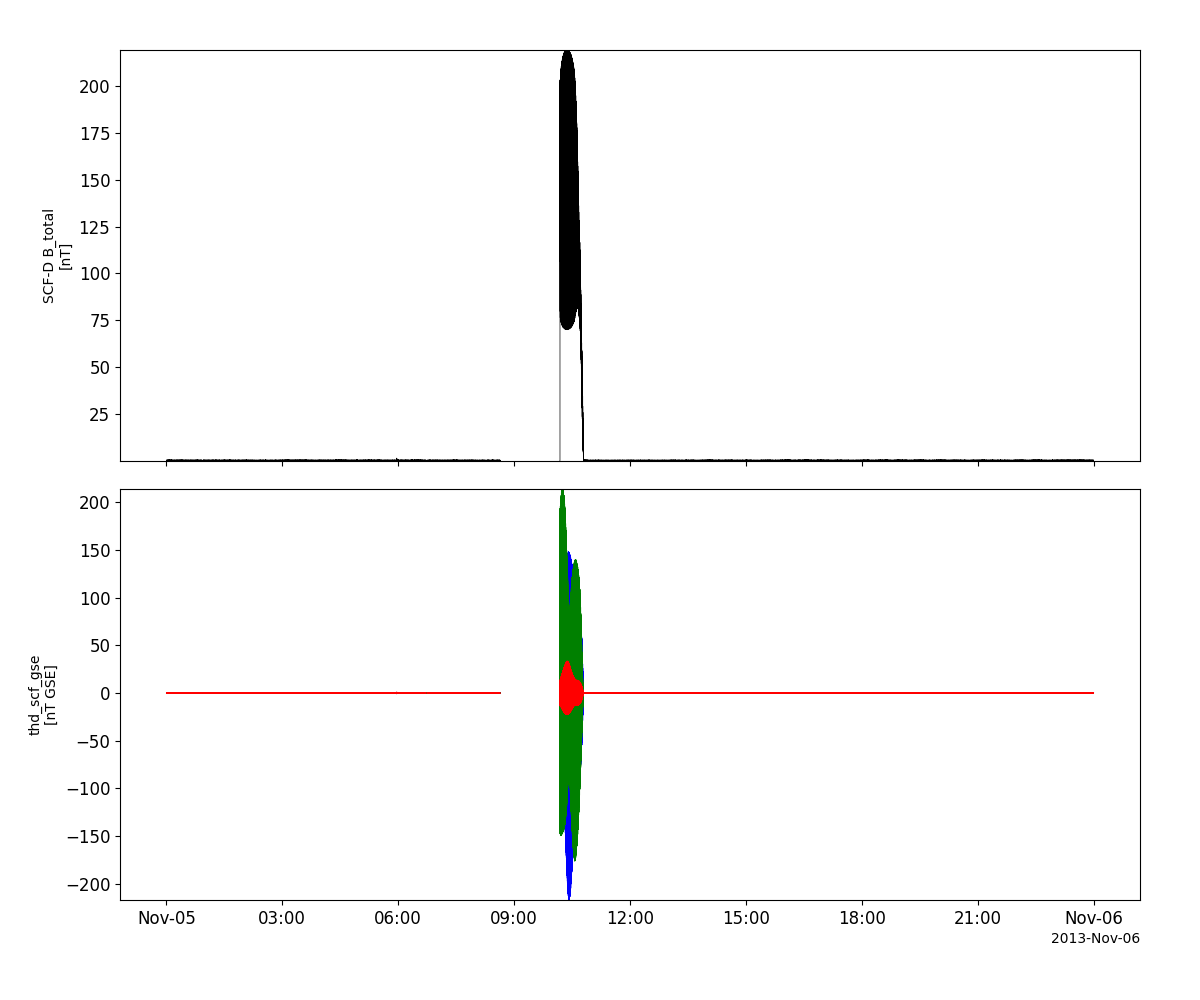
>>> scm_vars = pyspedas.projects.themis.scm(probe='d', trange=['2013-11-05', '2013-11-06'])
>>> tplot(['thd_scf_btotal', 'thd_scf_gse'])
Example
import pyspedas
from pyspedas import tplot
scm_vars = pyspedas.projects.themis.scm(probe='d', trange=['2013-11-5', '2013-11-6'])
tplot(['thd_scf_btotal', 'thd_scf_gse'])
Electric Field Instrument (EFI)
- pyspedas.projects.themis.efi(trange=['2007-03-23', '2007-03-24'], probe='c', level='l2', datatype=None, suffix='', get_support_data=False, varformat=None, varnames=[], downloadonly=False, notplot=False, no_update=False, time_clip=False)[source]
This function loads Electric Field Instrument (EFI) data
- Parameters:
trange (
listofstr) – time range of interest [starttime, endtime] with the format ‘YYYY-MM-DD’,’YYYY-MM-DD’] or to specify more or less than a day [‘YYYY-MM-DD/hh:mm:ss’,’YYYY-MM-DD/hh:mm:ss’] Default: [‘2007-03-23’, ‘2007-03-24’]probe (
strorlistofstr) – Spacecraft probe letter(s) (‘a’, ‘b’, ‘c’, ‘d’ and/or ‘e’) Default: ‘c’level (
str) – Processing level; Valid options: ‘l1’, ‘l2’ Default: ‘l2’datatype (
strorlistofstr) –Data type; Valid L1 options:
'eff', Fast survey E12, E34, E56 waveforms
'efp', Particle burst E12, E34, E56 waveforms
'efw', Wave burst E12 E34, E56 waveforms
'vaf', Fast survey voltage group A, V1-V6 boom voltages
'vap', Particle burst voltage group A, V1-V6 boom voltages
'vaw', Wave burst voltage group A, V1-V6 boom voltages
'vbf', Fast survey voltage group B, V1-V6 boom voltages
'vbp', Particle burst voltage group B, V1-V6 boom voltages
'vbw', Wave burst voltage group B, V1-V6 boom voltages
L1 default: [eff. efp, efw, vaf. vap, vaw]
Valid L2 options:
'efi', Fast survey E field vectors and other quantities
'efp', Particle burst E field vectors
'efw', Wave burst E field vectors
L2 default: efi
suffix (
str) – The tplot variable names will be given this suffix. Default: no suffixget_support_data (
bool) – Data with an attribute “VAR_TYPE” with a value of “support_data” will be loaded into tplot. Default: False; only loads data with a “VAR_TYPE” attribute of “data”varformat (
str) – The file variable formats to load into tplot. Wildcard character “*” is accepted. Default: None; all variables are loadedvarnames (
listofstr) – List of variable names to load Default: Empty list, so all data variables are loadeddownloadonly (
bool) – Set this flag to download the CDF files, but not load them into tplot variables Default: Falsenotplot (
bool) – Return the data in hash tables instead of creating tplot variables Default: Falseno_update (
bool) – If set, only load data from your local cache Default: Falsetime_clip (
bool) – Time clip the variables to exactly the range specified in the trange keyword Default: False
- Returns:
List of tplot variables created Empty list if no data
- Return type:
Listofstr
Example
>>> import pyspedas
>>> from pyspedas import tplot
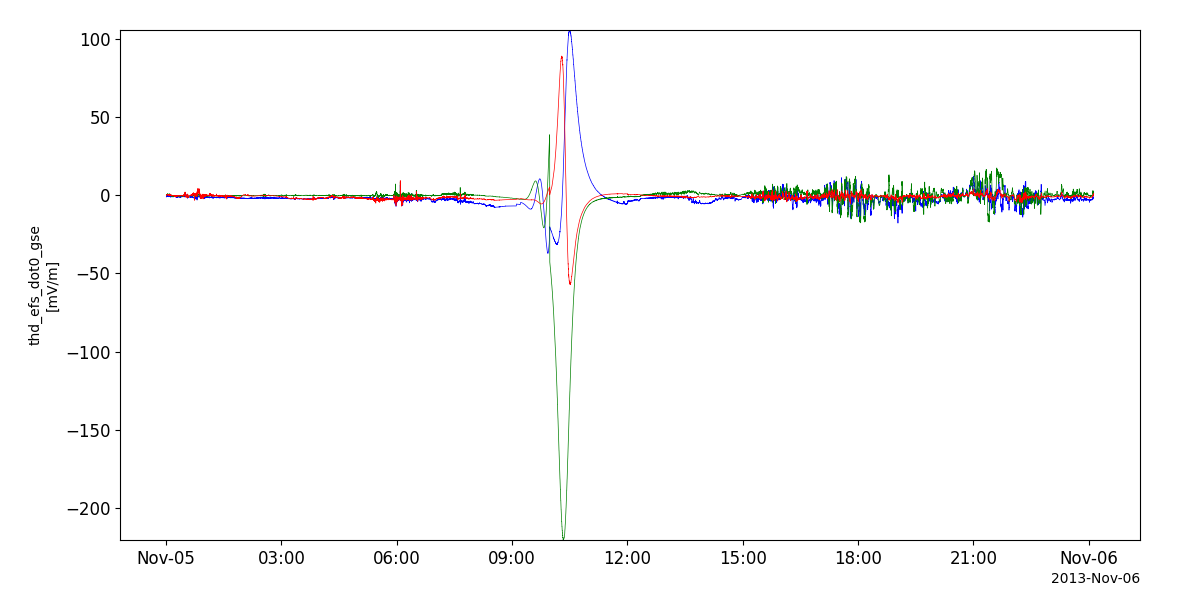
>>> efi_vars = pyspedas.projects.themis.efi(probe='d', trange=['2013-11-5', '2013-11-6'])
>>> tplot('thd_efs_dot0_gse')
Example
import pyspedas
from pyspedas import tplot
efi_vars = pyspedas.projects.themis.efi(probe='d', trange=['2013-11-5', '2013-11-6'])
tplot('thd_efs_dot0_gse')
Electrostatic Analyzer (ESA)
- pyspedas.projects.themis.esa(trange=['2007-03-23', '2007-03-24'], probe='c', level='l2', suffix='', get_support_data=False, varformat=None, varnames=[], downloadonly=False, notplot=False, no_update=False, time_clip=False)[source]
This function loads Electrostatic Analyzer (ESA) data
- Parameters:
trange (
listofstr) – time range of interest [starttime, endtime] with the format ‘YYYY-MM-DD’,’YYYY-MM-DD’] or to specify more or less than a day [‘YYYY-MM-DD/hh:mm:ss’,’YYYY-MM-DD/hh:mm:ss’] Default: [‘2007-03-23’, ‘2007-03-24’]probe (
strorlistofstr) – Spacecraft probe letter(s) (‘a’, ‘b’, ‘c’, ‘d’ and/or ‘e’) Default: ‘c’level (
str) – Data level; Valid options: ‘l1’, ‘l2’ Default: ‘l2’suffix (
str) – The tplot variable names will be given this suffix. Default: no suffixget_support_data (
bool) – Data with an attribute “VAR_TYPE” with a value of “support_data” will be loaded into tplot. Default: False; only loads data with a “VAR_TYPE” attribute of “data”varformat (
str) – The file variable formats to load into tplot. Wildcard character “*” is accepted. Default: None; all variables are loadedvarnames (
listofstr) – List of variable names to load Default: Empty list, so all data variables are loadeddownloadonly (
bool) – Set this flag to download the CDF files, but not load them into tplot variables Default: Falsenotplot (
bool) – Return the data in hash tables instead of creating tplot variables Default: Falseno_update (
bool) – If set, only load data from your local cache Default: Falsetime_clip (
bool) – Time clip the variables to exactly the range specified in the trange keyword Default: False
- Returns:
List of tplot variables created Empty list if no data
- Return type:
Listofstr
Example
>>> import pyspedas
>>> from pyspedas import tplot
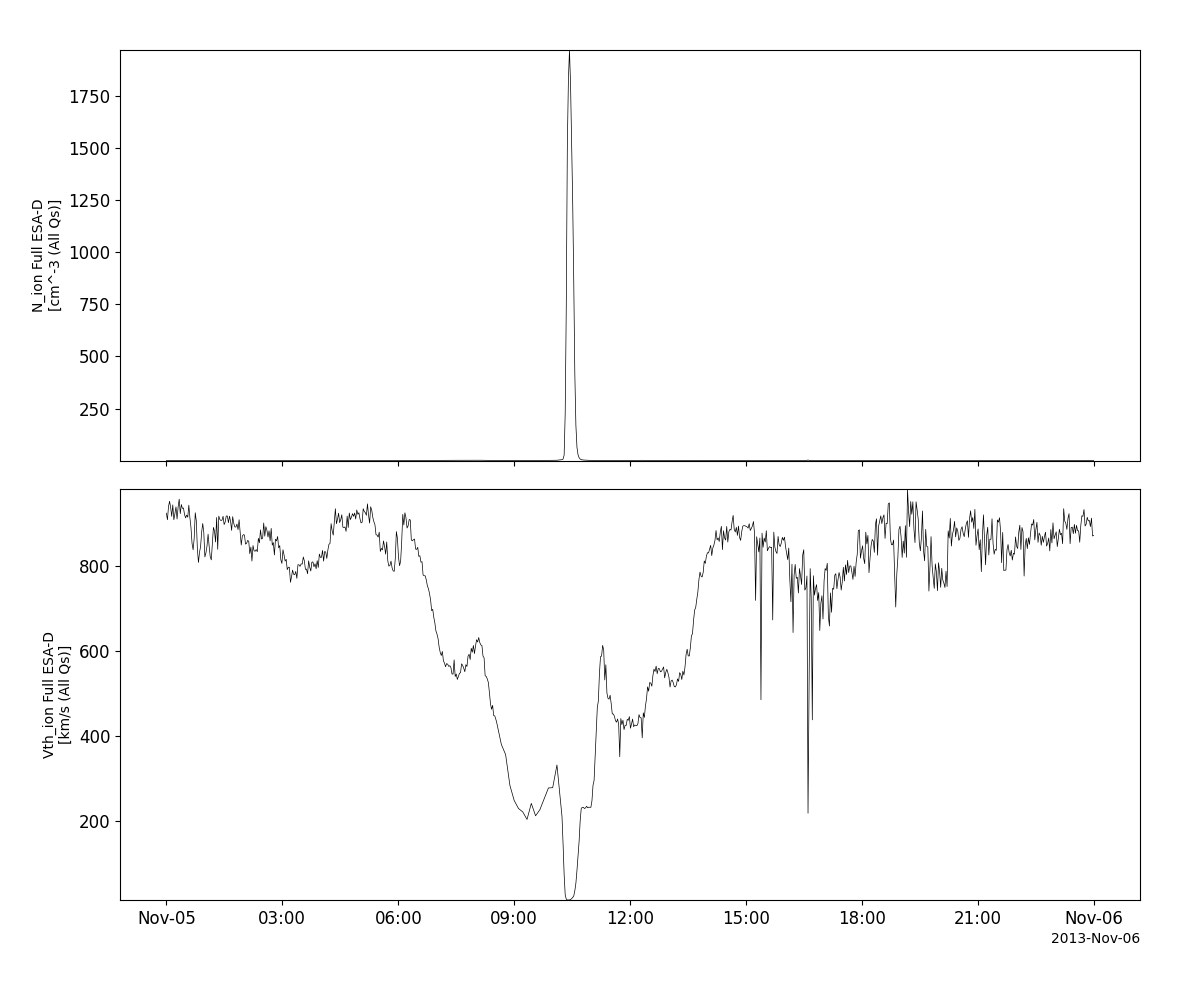
>>> esa_vars = pyspedas.projects.themis.esa(probe='d', trange=['2013-11-5', '2013-11-6'])
>>> tplot(['thd_peif_density', 'thd_peif_vthermal'])
Example
import pyspedas
from pyspedas import tplot
esa_vars = pyspedas.projects.themis.esa(probe='d', trange=['2013-11-5', '2013-11-6'])
tplot(['thd_peif_density', 'thd_peif_vthermal'])
Solid State Telescope (SST)
- pyspedas.projects.themis.sst(trange=['2007-03-23', '2007-03-24'], probe='c', level='l2', suffix='', get_support_data=False, varformat=None, varnames=[], downloadonly=False, notplot=False, no_update=False, time_clip=False)[source]
This function loads Solid State Telescope (SST) data
- Parameters:
trange (
listofstr) – time range of interest [starttime, endtime] with the format ‘YYYY-MM-DD’,’YYYY-MM-DD’] or to specify more or less than a day [‘YYYY-MM-DD/hh:mm:ss’,’YYYY-MM-DD/hh:mm:ss’] Default: [‘2007-03-23’, ‘2007-03-24’]probe (
strorlistofstr) – Spacecraft probe letter(s) (‘a’, ‘b’, ‘c’, ‘d’ and/or ‘e’) Default: ‘c’level (
str) – Data level; Valid options: ‘l1’, ‘l2’ Default: ‘l2’suffix (
str) – The tplot variable names will be given this suffix. Default: no suffixget_support_data (
bool) – Data with an attribute “VAR_TYPE” with a value of “support_data” will be loaded into tplot. Default: False; only loads data with a “VAR_TYPE” attribute of “data”varformat (
str) – The file variable formats to load into tplot. Wildcard character “*” is accepted. Default: None; all variables are loadedvarnames (
listofstr) – List of variable names to load Default: Empty list, so all data variables are loadeddownloadonly (
bool) – Set this flag to download the CDF files, but not load them into tplot variables Default: Falsenotplot (
bool) – Return the data in hash tables instead of creating tplot variables Default: Falseno_update (
bool) – If set, only load data from your local cache Default: Falsetime_clip (
bool) – Time clip the variables to exactly the range specified in the trange keyword Default: False
- Returns:
List of tplot variables created Empty list if no data
- Return type:
Listofstr
Notes
The thx_*_atten variables produced when loading SST L1 data contain 4 status bits, representing the state of the attenuators on the two SST sensor heads, defined as:
(MSB) Open Equatorial Attenuator,
Closed Equatorial Attenuator,
Open Polar Attenuator,
(LSB) Closed Polar Attenuator
With MSB/LSB not representing actual bits, but as labels to clarify bit order. Some examples:
0x5: both attenuators closed
0xA: both attenuators open
0x6: equatorial closed, polar open  (Occurs during stuck atten error on themis D)
0xf: Error state. Invalid data.
0x9: equatorial open, polar closed (This should never actually happen)
Example
>>> import pyspedas
>>> from pyspedas import tplot
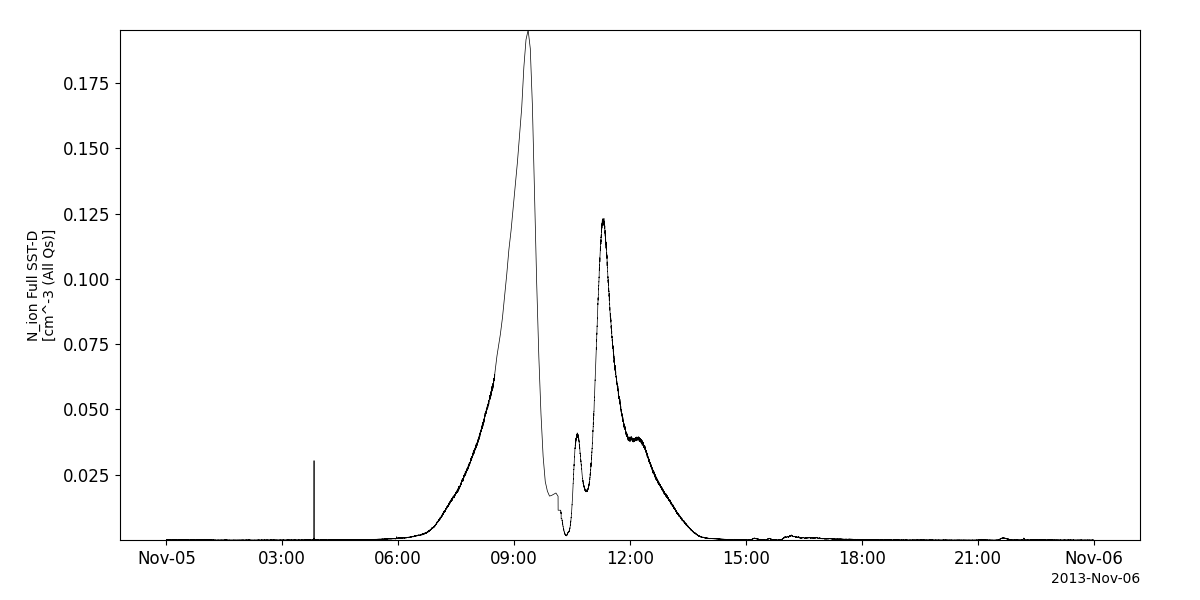
>>> sst_vars = pyspedas.projects.themis.sst(probe='d', trange=['2013-11-5', '2013-11-6'])
>>> tplot('thd_psif_density')
Example
import pyspedas
from pyspedas import tplot
sst_vars = pyspedas.projects.themis.sst(probe='d', trange=['2013-11-5', '2013-11-6'])
tplot('thd_psif_density')
Onboard Filter Bank Data (FBK)
- pyspedas.projects.themis.fbk(trange=['2007-03-23', '2007-03-24'], probe='c', level='l2', suffix='', get_support_data=False, varformat=None, varnames=[], downloadonly=False, notplot=False, no_update=False, time_clip=False)[source]
This function loads THEMIS FBK data
- Parameters:
trange – list of str time range of interest [starttime, endtime] with the format ‘YYYY-MM-DD’,’YYYY-MM-DD’] or to specify more or less than a day [‘YYYY-MM-DD/hh:mm:ss’,’YYYY-MM-DD/hh:mm:ss’] Default: [‘2007-03-23’, ‘2007-03-24’]
probe – str or list of str Spacecraft probe letter(s) (‘a’, ‘b’, ‘c’, ‘d’ and/or ‘e’) Default: ‘c’
level – str Data level; Valid options: ‘l1’, ‘l2’ Default: ‘l2’
level – str Data level; Valid options: ‘l1’, ‘l2’ Default: ‘l2’
suffix – str The tplot variable names will be given this suffix. Default: no suffix
get_support_data – bool Data with an attribute “VAR_TYPE” with a value of “support_data” will be loaded into tplot. Default: False; only loads data with a “VAR_TYPE” attribute of “data”
varformat – str The file variable formats to load into tplot. Wildcard character “*” is accepted. Default: None; all variables are loaded
varnames – list of str List of variable names to load Default: Empty list, so all data variables are loaded
downloadonly – bool Set this flag to download the CDF files, but not load them into tplot variables Default: False
notplot – bool Return the data in hash tables instead of creating tplot variables Default: False
no_update – bool If set, only load data from your local cache Default: False
time_clip – bool Time clip the variables to exactly the range specified in the trange keyword Default: False
- Returns:
List of tplot variables created Empty list if no data
- Return type:
Listofstr
Example
>>> import pyspedas
>>> from pyspedas import tplot
>>> fbk_vars = pyspedas.projects.themis.fbk(probe='d', trange=['2013-11-5', '2013-11-6'])
>>> tplot(['thd_fb_edc12', 'thd_fb_scm1'])
Onboard FFT Data (FFT)
- pyspedas.projects.themis.fft(trange=['2007-03-23', '2007-03-24'], probe='c', level='l2', suffix='', get_support_data=False, varformat=None, varnames=[], downloadonly=False, notplot=False, no_update=False, time_clip=False)[source]
This function loads THEMIS FFT data
- Parameters:
trange (
listofstr) – time range of interest [starttime, endtime] with the format ‘YYYY-MM-DD’,’YYYY-MM-DD’] or to specify more or less than a day [‘YYYY-MM-DD/hh:mm:ss’,’YYYY-MM-DD/hh:mm:ss’] Default: [‘2007-03-23’, ‘2007-03-24’]probe (
strorlistofstr) – Spacecraft probe letter(s) (‘a’, ‘b’, ‘c’, ‘d’ and/or ‘e’) Default: ‘c’level (
str) – Data level; Valid options: ‘l1’, ‘l2’ Default: ‘l2’suffix (
str) – The tplot variable names will be given this suffix. Default: no suffixget_support_data (
bool) – Data with an attribute “VAR_TYPE” with a value of “support_data” will be loaded into tplot. Default: False; only loads data with a “VAR_TYPE” attribute of “data”varformat (
str) – The file variable formats to load into tplot. Wildcard character “*” is accepted. Default: None; all variables are loadedvarnames (
listofstr) – List of variable names to load Default: Empty list, so all data variables are loadeddownloadonly (
bool) – Set this flag to download the CDF files, but not load them into tplot variables Default: Falsenotplot (
bool) – Return the data in hash tables instead of creating tplot variables Default: Falseno_update (
bool) – If set, only load data from your local cache Default: Falsetime_clip (
bool) – Time clip the variables to exactly the range specified in the trange keyword Default: False
- Returns:
List of tplot variables created Empty list if no data
- Return type:
Listofstr
Example
>>> import pyspedas
>>> from pyspedas import tplot
>>> fft_vars = pyspedas.projects.themis.fft(probe='d', trange=['2013-11-5', '2013-11-6'])
>>> tplot(['thd_fff_32_edc12','thd_fff_32_scm2'])
Onboard Moments Data (MOM)
- pyspedas.projects.themis.mom(trange=['2008-03-23', '2008-03-24'], probe='c', level='l2', suffix='', get_support_data=False, varformat=None, varnames=[], downloadonly=False, notplot=False, no_update=False, time_clip=False)[source]
This function loads THEMIS moments data
- Parameters:
trange (
listofstr) – time range of interest [starttime, endtime] with the format ‘YYYY-MM-DD’,’YYYY-MM-DD’] or to specify more or less than a day [‘YYYY-MM-DD/hh:mm:ss’,’YYYY-MM-DD/hh:mm:ss’] Default: [‘2008-03-23’, ‘2008-03-24’]probe (
strorlistofstr) – Spacecraft probe letter(s) (‘a’, ‘b’, ‘c’, ‘d’ and/or ‘e’) Default: ‘c’level (
str) – Data level; Valid options: ‘l1’, ‘l2’ Default: ‘l2’level (
str) – Data level; Valid options: ‘l2’ Default: ‘l2’suffix (
str) – The tplot variable names will be given this suffix. Default: no suffixget_support_data (
bool) – Data with an attribute “VAR_TYPE” with a value of “support_data” will be loaded into tplot. Default: False; only loads data with a “VAR_TYPE” attribute of “data”varformat (
str) – The file variable formats to load into tplot. Wildcard character “*” is accepted. Default: None; all variables are loadedvarnames (
listofstr) – List of variable names to load Default: Empty list, so all data variables are loadeddownloadonly (
bool) – Set this flag to download the CDF files, but not load them into tplot variables Default: Falsenotplot (
bool) – Return the data in hash tables instead of creating tplot variables Default: Falseno_update (
bool) – If set, only load data from your local cache Default: Falsetime_clip (
bool) – Time clip the variables to exactly the range specified in the trange keyword Default: False
- Returns:
List of tplot variables created Empty list if no data
- Return type:
Listofstr
Example
>>> import pyspedas
>>> from pyspedas import tplot
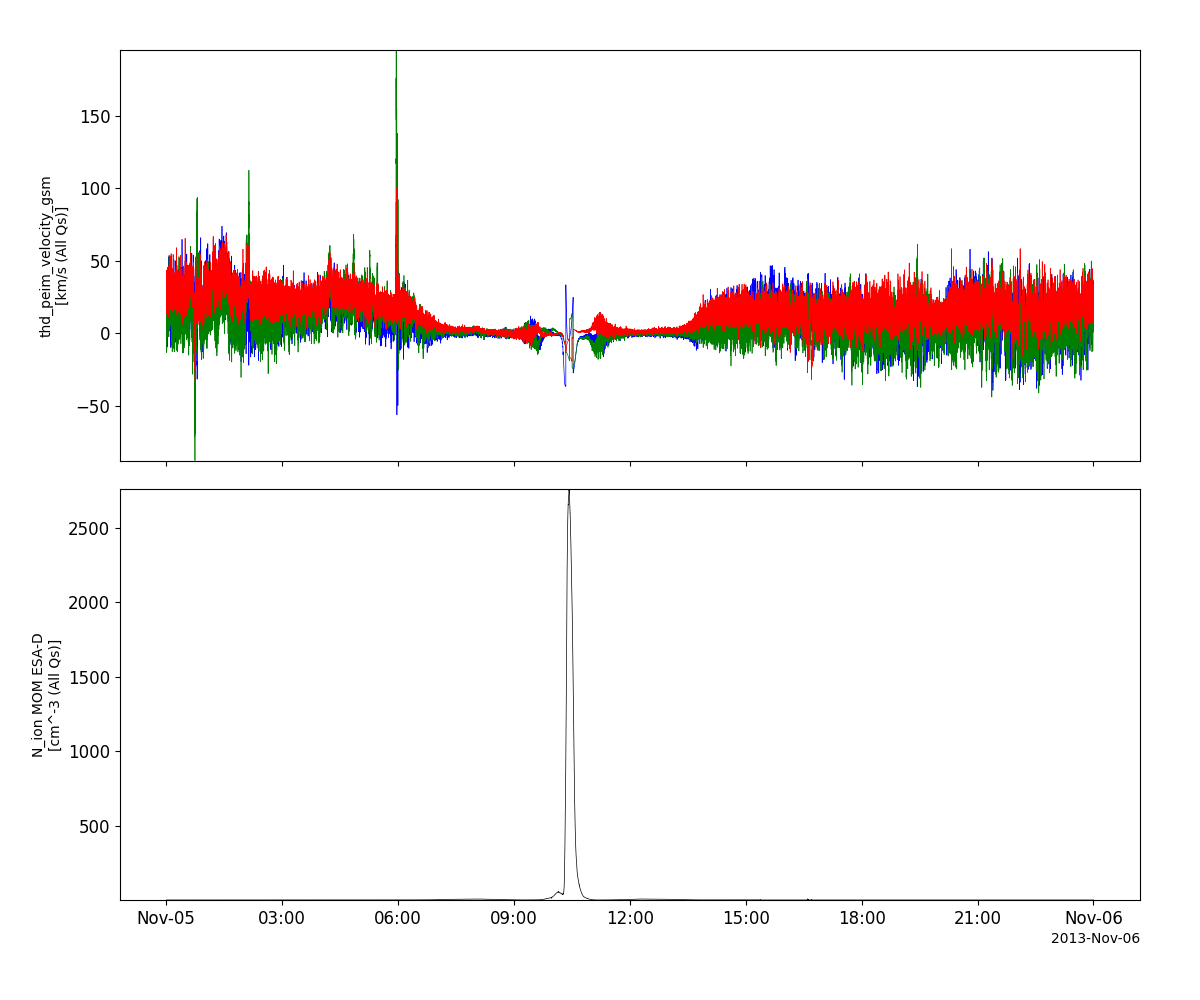
>>> mom_vars = pyspedas.projects.themis.mom(probe='d', trange=['2013-11-5', '2013-11-6'])
>>> tplot(['thd_peim_velocity_gsm', 'thd_peim_density'])
Example
import pyspedas
from pyspedas import tplot
mom_vars = pyspedas.projects.themis.mom(probe='d', trange=['2013-11-5', '2013-11-6'])
tplot(['thd_peim_velocity_gsm', 'thd_peim_density'])
Ground computed moments data (GMOM)
- pyspedas.projects.themis.gmom(trange=['2007-03-23', '2007-03-24'], probe='c', level='l2', suffix='', get_support_data=False, varformat=None, varnames=[], downloadonly=False, notplot=False, no_update=False, time_clip=False)[source]
This function loads THEMIS Level 2 ground calculated combined ESA+SST moments.
- Parameters:
trange (
listofstr) – time range of interest [starttime, endtime] with the format ‘YYYY-MM-DD’,’YYYY-MM-DD’] or to specify more or less than a day [‘YYYY-MM-DD/hh:mm:ss’,’YYYY-MM-DD/hh:mm:ss’] Default: [‘2007-03-23’, ‘2007-03-24’]probe (
strorlistofstr) – Spacecraft probe letter(s) (‘a’, ‘b’, ‘c’, ‘d’ and/or ‘e’) Default: ‘c’level (
str) – Data level; Valid options: ‘l2’ Default: ‘l2’suffix (
str) – The tplot variable names will be given this suffix. Default: no suffixget_support_data (
bool) – Data with an attribute “VAR_TYPE” with a value of “support_data” will be loaded into tplot. Default: False; only loads data with a “VAR_TYPE” attribute of “data”varformat (
str) – The file variable formats to load into tplot. Wildcard character “*” is accepted. Default: None; all variables are loadedvarnames (
listofstr) – List of variable names to load Default: Empty list, so all data variables are loadeddownloadonly (
bool) – Set this flag to download the CDF files, but not load them into tplot variables Default: Falsenotplot (
bool) – Return the data in hash tables instead of creating tplot variables Default: Falseno_update (
bool) – If set, only load data from your local cache Default: Falsetime_clip (
bool) – Time clip the variables to exactly the range specified in the trange keyword Default: False
- Returns:
List of tplot variables created Empty list if no data
- Return type:
Listofstr
Example
>>> import pyspedas
>>> from pyspedas import tplot
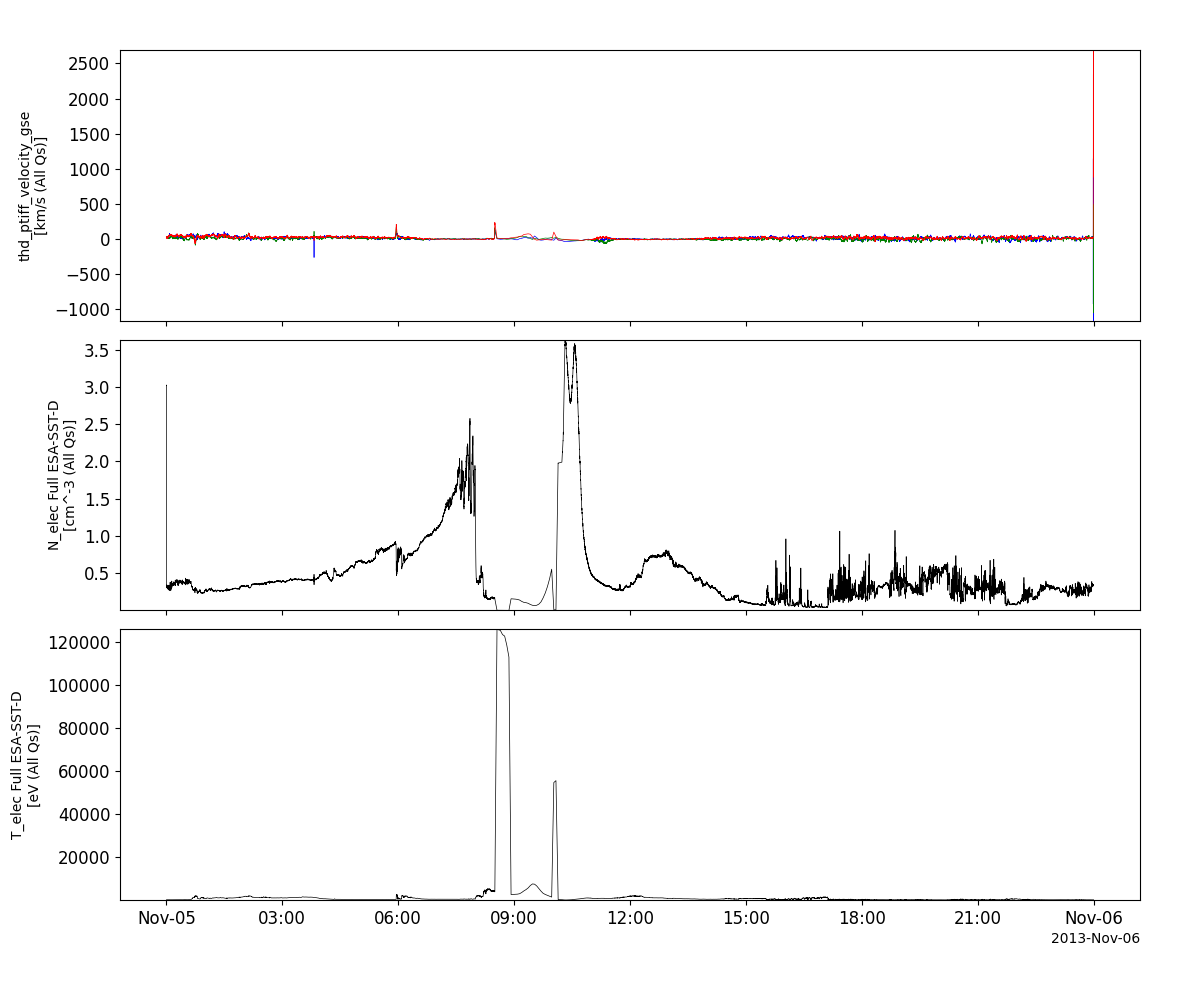
>>> gmom_vars = pyspedas.projects.themis.gmom(probe='d', trange=['2013-11-5', '2013-11-6'])
>>> tplot(['thd_ptiff_velocity_gse', 'thd_pteff_density', 'thd_pteff_avgtemp'])
Example
import pyspedas
from pyspedas import tplot
gmom_vars = pyspedas.projects.themis.gmom(probe='d', trange=['2013-11-5', '2013-11-6'])
tplot(['thd_ptiff_velocity_gse', 'thd_pteff_density', 'thd_pteff_avgtemp'])
State data (STATE)
- pyspedas.projects.themis.state(trange=['2007-03-23', '2007-03-24'], probe='c', level='l1', suffix='', get_support_data=False, varformat=None, exclude_format=None, varnames=[], downloadonly=False, notplot=False, no_update=False, time_clip=False, keep_spin=False)[source]
Load THEMIS state data
- Parameters:
trange (
listofstr) – time range of interest [starttime, endtime] with the format [‘YYYY-MM-DD’,’YYYY-MM-DD’] or to specify more or less than a day [‘YYYY-MM-DD/hh:mm:ss’,’YYYY-MM-DD/hh:mm:ss’] Default: [‘2007-03-23’, ‘2007-03-24’]probe (
strorlistofstr) – Spacecraft probe letter(s) (‘a’, ‘b’, ‘c’, ‘d’ and/or ‘e’) Default: ‘c’level (
str) – Data type; Valid options: ‘l1’ Default: ‘l1’suffix (
str) – The tplot variable names will be given this suffix. Default: Noneget_support_data (
bool) – Data with an attribute “VAR_TYPE” with a value of “support_data” will be loaded into tplot. Default: Falsevarformat (
str) – The file variable formats to load into tplot. Wildcard character “*” is accepted. By default, all variables are loaded in. Default: None (all variables are loaded)exclude_format (
str) – If specified, CDF variables matching this pattern will not be processed. Wildcard character “*” is accepted. Default: Nonevarnames (
listofstr) – List of variable names to load. If list is empty or unsoecified, all data variables are loaded Default: [] (all variables are loaded)downloadonly (
bool) – Set this flag to download the CDF files, but not load them into tplot variables Default: falsenotplot (
bool) – Return the data in hash tables instead of creating tplot variables Default: falseno_update (
bool) – If set, only load data from your local cache Default: falsetime_clip (
bool) – Time clip the variables to exactly the range specified in the trange keyword Default: falsekeep_spin (
bool) – If True, do not delete the spin model tplot variables after the spin models are built. Default: False
- Returns:
ListofstrListoftplot variables createdEmpty list if no data loaded
Example
>>> import pyspedas
>>> from pyspedas import tplot
>>> pyspedas.projects.themis.state(trange=['2007-03-23', '2007-03-24'], probe='a', varnames=['tha_pos_gse','tha_vel_gse'])
>>> tplot['tha_pos_gse', 'tha_vel_gse'])
Example
import pyspedas
from pyspedas import tplot
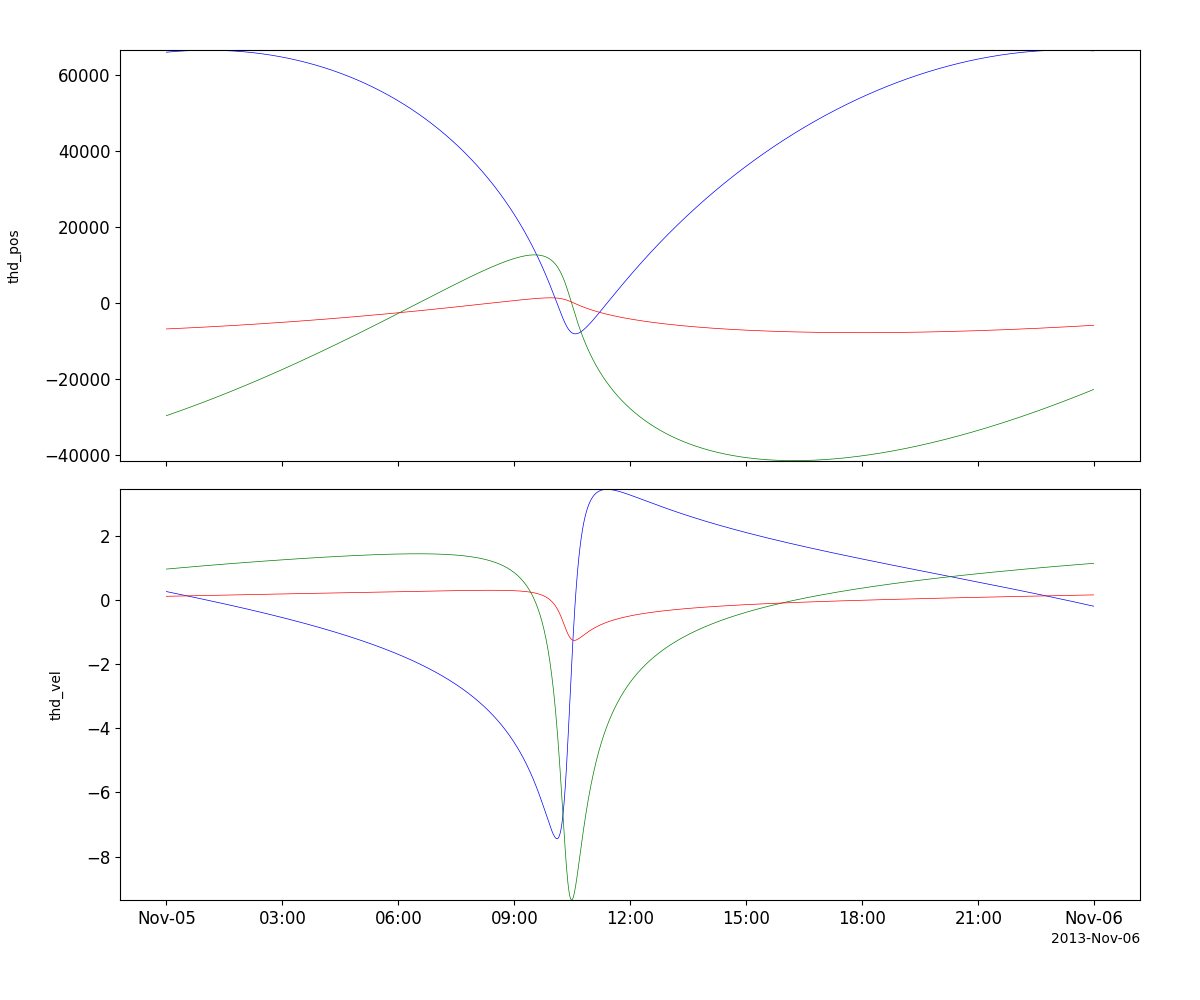
state_vars = pyspedas.projects.themis.state(probe='d', trange=['2013-11-5', '2013-11-6'])
tplot(['thd_pos', 'thd_vel'])
Orbit data from SSCWeb (SSC)
- pyspedas.projects.themis.ssc(trange=['2017-03-23', '2017-03-24'], probe='c', level='l2', suffix='', get_support_data=False, varformat=None, varnames=[], downloadonly=False, notplot=False, no_update=False, time_clip=True)[source]
Load THEMIS current/past orbit data from CDAWeb/SSCWeb (Satellite Situation Center).
For example: https://cdaweb.gsfc.nasa.gov/pub/data/themis/thc/ssc/
See also, pyspedas.projects.themis.state_tools.ssc_pre
- Parameters:
trange (
listofstr) – time range of interest [starttime, endtime] with the format ‘YYYY-MM-DD’,’YYYY-MM-DD’] or to specify more or less than a day [‘YYYY-MM-DD/hh:mm:ss’,’YYYY-MM-DD/hh:mm:ss’] Default: [‘2017-03-23’, ‘2017-03-24’]probe (
strorlistofstr) – Spacecraft probe letter(s) (‘a’, ‘b’, ‘c’, ‘d’ and/or ‘e’) Default: ‘c’level (
str) – Data type; Default: ‘l2’; Unused.suffix (
str) – The tplot variable names will be given this suffix. Default: no suffixget_support_data (
bool) – Data with an attribute “VAR_TYPE” with a value of “support_data” will be loaded into tplot. Default: False; only loads data with a “VAR_TYPE” attribute of “data”varformat (
str) – The file variable formats to load into tplot. Wildcard character “*” is accepted. Default: None; all variables are loadedvarnames (
listofstr) – List of variable names to load Default: Empty list, so all data variables are loadeddownloadonly (
bool) – Set this flag to download the CDF files, but not load them into tplot variables Default: Falsenotplot (
bool) – Return the data in hash tables instead of creating tplot variables Default: Falseno_update (
bool) – If set, only load data from your local cache Default: Falsetime_clip (
bool) – Time clip the variables to exactly the range specified in the trange keyword Default: True
- Returns:
List of tplot variables created Empty list if no data
- Return type:
Listofstr
Example
>>> from pyspedas.projects.themis import ssc
>>> vars = ssc(probe='d', trange=['2013-11-5', '2013-11-6'])
>>> print(vars)
Example
from pyspedas.projects.themis import ssc
ssc_vars = ssc(probe='d', trange=['2012-10-01', '2012-10-02'])
print(ssc_vars)

['GEO_LAT', 'GEO_LON', 'GEO_LCT_T', 'GM_LAT', 'GM_LON', 'GM_LCT_T', 'GSE_LAT', 'GSE_LON', 'GSE_LCT_T', 'GSM_LAT', 'GSM_LON', 'SM_LAT', 'SM_LON', 'SM_LCT_T', 'NorthBtrace_GEO_LAT', 'NorthBtrace_GEO_LON', 'NorthBtrace_GEO_ARCLEN', 'SouthBtrace_GEO_LAT', 'SouthBtrace_GEO_LON', 'SouthBtrace_GEO_ARCLEN', 'NorthBtrace_GM_LAT', 'NorthBtrace_GM_LON', 'NorthBtrace_GM_ARCLEN', 'SouthBtrace_GM_LAT', 'SouthBtrace_GM_LON', 'SouthBtrace_GM_ARCLEN', 'RADIUS', 'MAG_STRTH', 'DNEUTS', 'BOW_SHOCK', 'MAG_PAUSE', 'L_VALUE', 'INVAR_LAT', 'MAG_X', 'MAG_Y', 'MAG_Z', 'XYZ_GEO', 'XYZ_GM', 'XYZ_GSE', 'XYZ_GSM', 'XYZ_SM']
Orbit predictions from SSCWeb (SSC_PRE)
- pyspedas.projects.themis.ssc_pre(trange=['2026-03-23', '2026-03-24'], probe='c', level='l2', suffix='', get_support_data=False, varformat=None, varnames=[], downloadonly=False, notplot=False, no_update=False, time_clip=True)[source]
Load THEMIS predicted orbit data from CDAWeb/SSCWeb (Satellite Situation Center).
For example: https://cdaweb.gsfc.nasa.gov/pub/data/themis/thc/ssc_pre/ Each downloaded file contains data for a full year.
See also, pyspedas.projects.themis.state_tools.ssc
- Parameters:
trange (
listofstr) – time range of interest [starttime, endtime] with the format ‘YYYY-MM-DD’,’YYYY-MM-DD’] or to specify more or less than a day [‘YYYY-MM-DD/hh:mm:ss’,’YYYY-MM-DD/hh:mm:ss’] Default: [‘2017-03-23’, ‘2017-03-24’]probe (
strorlistofstr) – Spacecraft probe letter(s) (‘a’, ‘b’, ‘c’, ‘d’ and/or ‘e’) Default: ‘c’level (
str) – Data type; Default: ‘l2’; Unused.suffix (
str) – The tplot variable names will be given this suffix. Default: no suffixget_support_data (
bool) – Data with an attribute “VAR_TYPE” with a value of “support_data” will be loaded into tplot. Default: False; only loads data with a “VAR_TYPE” attribute of “data”varformat (
str) – The file variable formats to load into tplot. Wildcard character “*” is accepted. Default: None; all variables are loadedvarnames (
listofstr) – List of variable names to load Default: Empty list, so all data variables are loadeddownloadonly (
bool) – Set this flag to download the CDF files, but not load them into tplot variables Default: Falsenotplot (
bool) – Return the data in hash tables instead of creating tplot variables Default: Falseno_update (
bool) – If set, only load data from your local cache Default: Falsetime_clip (
bool) – Time clip the variables to exactly the range specified in the trange keyword Default: True
- Returns:
List of tplot variables created Empty list if no data
- Return type:
Listofstr
Example
>>> from pyspedas.projects.themis import ssc_pre
>>> vars = ssc_pre(probe='d', trange=['2026-12-25', '2026-12-26'])
>>> print(vars)
Example
from pyspedas.projects.themis import ssc_pre
ssc_pre_vars = ssc_pre(probe='a', trange=['2028-12-01', '2028-12-02'])
print(ssc_pre_vars)

['GEO_LAT', 'GEO_LON', 'GEO_LCT_T', 'GM_LAT', 'GM_LON', 'GM_LCT_T', 'GSE_LAT', 'GSE_LON', 'GSE_LCT_T', 'GSM_LAT', 'GSM_LON', 'SM_LAT', 'SM_LON', 'SM_LCT_T', 'NorthBtrace_GEO_LAT', 'NorthBtrace_GEO_LON', 'NorthBtrace_GEO_ARCLEN', 'SouthBtrace_GEO_LAT', 'SouthBtrace_GEO_LON', 'SouthBtrace_GEO_ARCLEN', 'NorthBtrace_GM_LAT', 'NorthBtrace_GM_LON', 'NorthBtrace_GM_ARCLEN', 'SouthBtrace_GM_LAT', 'SouthBtrace_GM_LON', 'SouthBtrace_GM_ARCLEN', 'RADIUS', 'MAG_STRTH', 'DNEUTS', 'BOW_SHOCK', 'MAG_PAUSE', 'L_VALUE', 'INVAR_LAT', 'MAG_X', 'MAG_Y', 'MAG_Z', 'XYZ_GEO', 'XYZ_GM', 'XYZ_GSE', 'XYZ_GSM', 'XYZ_SM']
Ground Magnetometer Data (GMAG)
- pyspedas.projects.themis.gmag(trange=['2007-03-23', '2007-03-24'], sites=None, group=None, level='l2', prefix='', suffix='', get_support_data=False, varformat=None, varnames=[], downloadonly=False, notplot=False, no_update=False, time_clip=False, force_download=False, sampling_rate=1)[source]
Load ground magnetometer data from the THEMIS mission.
- Parameters:
trange (
list, optional) – Time range of interest in the format [“start_date”, “end_date”]. Default is [“2007-03-23”, “2007-03-24”].sites (
listorstr, optional) – List of ground magnetometer sites to load data for. If None, data for all available sites will be loaded. Default is None.group (
str, optional) – Name of a pre-defined group of sites to load data for. If specified, the ‘sites’ parameter will be ignored. Default is None.level (
str, optional) – Data level to load. Default is “l2”.prefix (
str, optional) – Prefix to append to the variable names. Default is “”.suffix (
str, optional) – Suffix to append to the variable names. Default is “”.get_support_data (
bool, optional) – Flag indicating whether to download support data. Default is False.varformat (
str, optional) – Format of the variable names. Default is None.varnames (
list, optional) – List of specific variable names to load. Default is [].downloadonly (
bool, optional) – Flag indicating whether to only download the data without loading it. Default is False.notplot (
bool, optional) – Flag indicating whether to plot the loaded data. Default is False.no_update (
bool, optional) – Flag indicating whether to update the data files. Default is False.time_clip (
bool, optional) – Flag indicating whether to clip the data to the specified time range. Default is False.force_download (
bool, optional) – Download file even if local version is more recent than server version Default: Falsesampling_rate (
int, optional) – Specify a sampling rate for loading variometer data. Accepts 1 (Hz) or 10 (Hz). Default: 1
- Returns:
A dictionary containing the loaded data.
- Return type:
Examples
>>> from pyspedas.projects.themis import gmag
>>> from pyspedas import tplot
>>> from pyspedas import subtract_median
>>>
>>> # Load ground magnetometer data for specific sites and time range
>>> gmag_vars = gmag(sites=['ccnv','bmls'], trange=['2013-11-05', '2013-11-06'])
>>> tplot(['thg_mag_bmls', 'thg_mag_ccnv'])
>>>
>>> # Load variometer data for specific sites and time range:
>>> gmag_vars = gmag(sites=['s61a','anmo'], trange=['2026-02-24', '2026-02-25'])
>>> subtract_median(['thg_mag_s61a', 'thg_mag_anmo'])
>>> tplot(['thg_mag_s61a-m', 'thg_mag_anmo-m'])
>>>
>>> # Load 10 Hz variometer data for specific sites and time range:
>>> gmag_vars = gmag(sites=['s61a','anmo'], sampling_rate=10, trange=['2026-02-24', '2026-02-25'])
>>> subtract_median(['thg_mag_s61a_100ms', 'thg_mag_anmo_100ms'])
>>> tplot(['thg_mag_s61a_100ms-m', 'thg_mag_anmo_100ms-m'])
>>>
>>> # Load 10 Hz variometer data for specific sites and time range using the 10 Hz file name format:
>>> gmag_vars = gmag(sites=['s61a_100ms','anmo_100ms'], trange=['2026-02-24', '2026-02-25'])
>>> subtract_median(['thg_mag_s61a_100ms', 'thg_mag_anmo_100ms'])
>>> tplot(['thg_mag_s61a_100ms-m', 'thg_mag_anmo_100ms-m'])
>>>
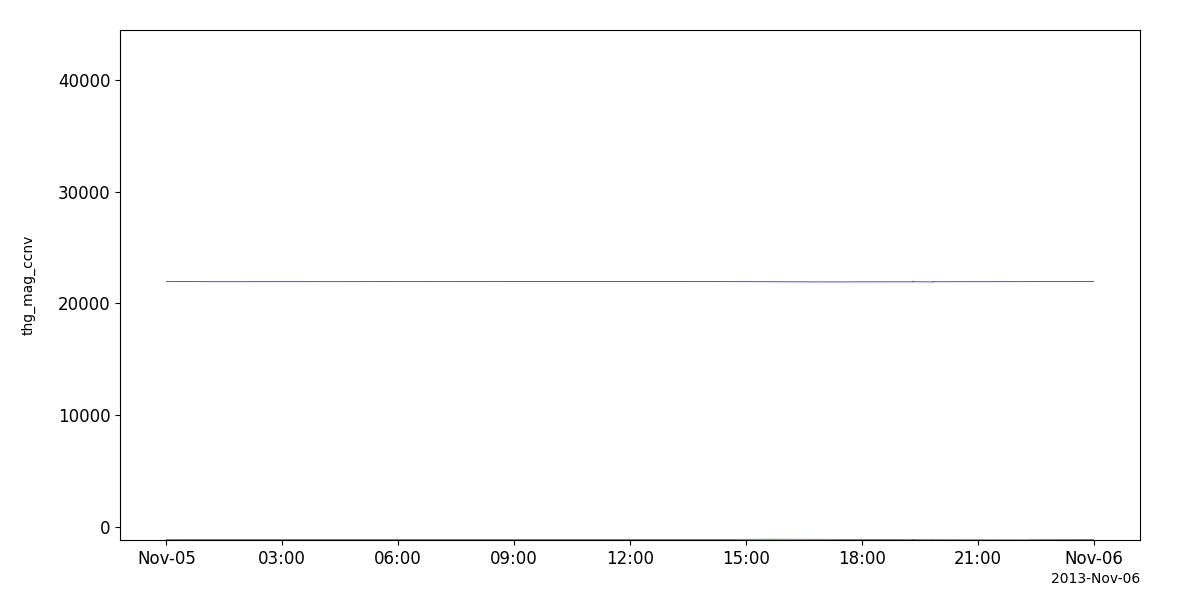
Example
import pyspedas
from pyspedas import tplot
gmag_vars = pyspedas.projects.themis.gmag(sites='ccnv', trange=['2013-11-5', '2013-11-6'])
tplot('thg_mag_ccnv')